This post may contain affiliate links. When you make a purchase using one of these links, I get paid a small commission at no extra cost to you.
Additionally, I encourage you to check your local thrift stores, Buy Nothing groups and with friends/family for most items before purchasing something new, even through one of these links. It will be better for your wallet and the planet! You can also rent most necessary gear in Moshi or Arusha, usually through your hired trekking company. The exception is your hiking shoes. I recommend buying quality hiking shoes or boots new and breaking them in so they mold better to your feet.
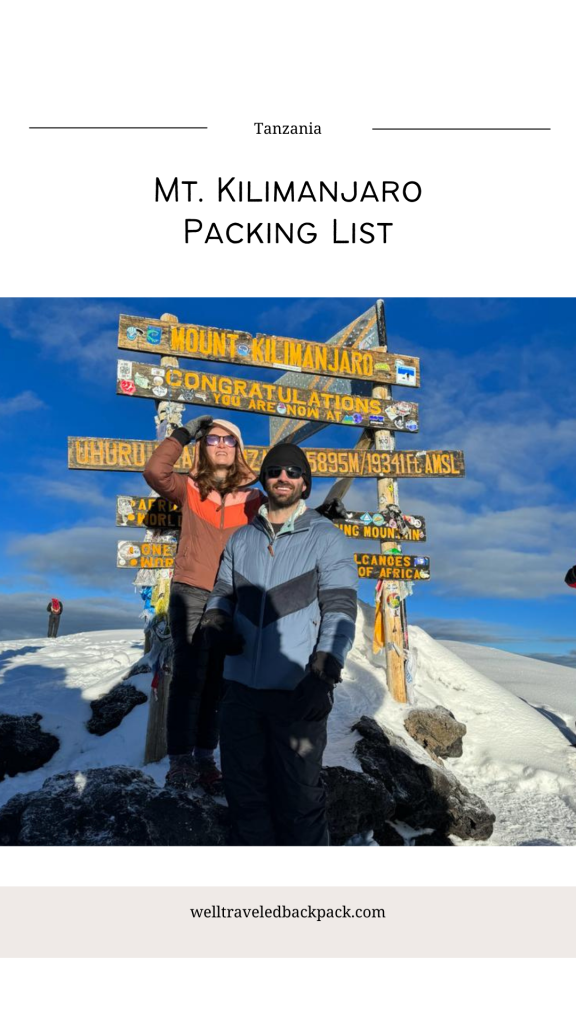
Climbing Mount Kilimanjaro was one of my most difficult physical accomplishments yet. My husband and I did the 8-day Lemosho route, battling altitude sickness, uncomfortable sleeping conditions and mental and physical discomforts.
Before climbing, I was full of questions about how to train and what to pack. My trekking company shared a packing list, but honestly it was a bit generic. So I wanted to share the Kilimanjaro packing list that worked for us.
If you are going on safari or to Zanzibar afterwards, make sure to pack for that as well! We went to Zanzibar and still fit everything inside our 40L backpacks. You can leave anything you don’t need in your larger bags at the hotel.
Be sure to also check out my full post on training and preparing for summiting Kilimanjaro for more detailed Kilimanjaro packing list explanations.
Read my Kilimanjaro packing list recommendations below!
Luggage
We are talking about carry-on only packing lists, so the luggage list will be carry-on as well! I always prefer traveling with backpacks only, when possible. You can usually bring a 35-50L backpack as your carry-on luggage on a plane, and a daypack or purse as your personal item. Check your airline’s regulations for carry-on size limitations.
- 40L Backpack [I recommend Osprey. I use the Fairview backpack, and my husband uses Farpoint.]
- 25-30L Comfortable Daypack [I recommend Osprey or REI.]
- 85L Waterproof duffle bag (rented in Moshi)
- Rain cover for backpack (rented in Moshi)
We opted to rent the duffles through our trekking company because we didn’t really want to spend $$$ on a high-quality duffle that was ultimately only going to be used once or so. The rental in Moshi was only $30 USD/person, so it was worth it.
Hiking/Camping Equipment
Before you pack your hiking equipment, make sure you check with your trekking company to learn what they provide included in the price versus what you’re expected to bring or rent. We chose to rent most of this equipment so we didn’t have to buy high-quality versions of items we rarely use, and so that we didn’t have to check a bag.
Most trekking companies will at least supply tents, meals and fresh water.
- Four seasons sleeping bag (rented in Moshi)
- Sleeping bag liner (rented in Moshi)
- Trekking poles (rented in Moshi)
- Crampons (rented in Moshi)
- Water bottles or bladder (enough to carry minimum 3L/person)
- Head lamp
- Fresh batteries if battery-powered
- Knee brace
- Hot Hands
- (Optional) Exercise watch (I use FitBit)
First Aid & Medication
You are going to be climbing a mountain for somewhere between 5-10 days, far from any medical attention. There are certainly ways to get you down the mountain quickly in case of an emergency, but you definitely want to avoid them, if possible.
Your trekking company will have some medical equipment to monitor heart rate and oxygen levels, and supply more oxygen if needed. However, for basic first aid, you want to be well-prepared.
- Altitude sickness medication (Diamox)
- Ibuprofen
- Antibiotics for stomach issues
- Imodium
- Emergen-C (for immune system boost & electrolytes)
- Antimalarials (Malarone)*
- Antibacterial ointment (e.g., Neosporin)
- Bandaids [link]
- Cranberry supplements**
- Antibiotics for UTI**
- Any regular medications***
* There aren’t mosquitoes for most of the climb except the very beginning and very end, and most companies recommend against taking antimalarials on the mountain due to negative side effects. However, if you are going on safari, visiting Zanzibar or planning other stops in Tanzania/East Africa, you can begin taking antimalarial medication on the second to last day of your hike.
**I read an account from a woman who got a UTI on her Kilimanjaro trek, so I brought these as precautions (though luckily didn’t need them). She said her UTI was from not wanting to leave her tent at night to empty her bladder in the cold. It’s also hard to stay clean on the trail, which can be an issue as well.
***If you take any regular over-the-counter medications, make sure to check with Tanzania customs to make sure you’re allowed to enter with them, or if you need a doctor’s note.
Beauty & Hygiene
A couple of things to keep in mind on the mountain is that the air is dry, and the UV is high. You want to make sure you have plenty of sunscreen and moisturizer to help you battle those elements.
Additionally, you have to find ways to be comfortable not showering for days in a row. Some of the more premium trekking companies have shower tents either included or for an extra cost. You’ll likely be taking baby wipe showers at most.
- Sunscreen
- Face moisturizer
- Lip balm with sunscreen
- Baby wipes
- Bug spray (first and last day)
- Deodorant
- Toothbrush
- Toothpaste
- Hair Ties
- 2x Headbands
- Disposable menstrual products (e.g., pads, tampons, disposable discs)*
- Bag for trash**
Also consider:
- Hand lotion
- Dry shampoo
* Even if you’re not due for your cycle, I recommend bringing products just in case. Altitude can affect it in weird ways sometimes. While I prefer reusable products, there aren’t really ways to disinfect them on the trail, so reusable is best.
** Your trekking company will have trash containers at camp, but not on the trail. We brought gallon ziplock bags to pack away toilet paper/baby wipes on the trail.
Food & Nutrition
Your trekking company will supply you with nutritious meals designed to keep you healthy and energized on the trail every day. On a couple of the particularly difficult days, they’ll also send you off with some simple snacks. Still, you want to pack some snacks you know you’ll be able to eat at any time – even when altitude is reducing your appetite.
- Electrolytes [I recommend Nuun]
- Protein bars
- Energy chews with caffeine [I recommend Clif Blocs]
- Chocolates
- Ginger chews (for altitude-induced nausea)
I recommend bringing more snacks than you think you might need. At the end of the trek, it’s customary to give extra/leftover snacks to the porters.
Don’t skip the ginger chews or Clif Blocs. I don’t see them on typical packing lists, but I wouldn’t have gotten through summit night without them!
Electronics & Entertainment
Another thing you won’t get on the trail is electricity (on most routes). We kept our phones on airplane mode the entire time to preserve battery, and because we didn’t have service most the time anyway. I’ve read they’re starting to make wifi available on some Kilimanjaro routes, but I’d recommend disconnecting if you can!
That said, you want to bring extra battery power for any electronics you do bring. I have battery packs that can hold multiple charges, which were so helpful. Additionally, bring some entertainment that doesn’t need electricity.
Keep in mind that any electronics you bring will have to sleep with you in your sleeping bag when you get up to the higher and colder camps. Otherwise, you risk them dying due to the weather.
- Portable battery packs (1-2/person)
- Kindle
- Journal & pen
- Sketchbook
- Playing cards
- (Optional) Go Pro or camera equipment
My Clothing List (5’1” woman)
This was my personal clothing packing list as a 5’1” woman. This list is what I personally used on my 8-day Lemosho trek in January.
And yes – all of this fit in my 40L Osprey backpack, with a little overflow from the accessories in my daypack. My clothes for Zanzibar also fit into the backpack along with my hiking clothes, but they’re not listed here.
- 2x pairs exercise pants
- 2x pairs lined leggings
- 1x pair down pants [link]
- 1x pair exercise shorts
- 6x exercise/hiking shirts
- 4x long sleeve shirts
- 1x fleece
- 1x down jacket [link]
- 1x shell jacket
- 2x long johns [link]
- 9x pairs of underwear
- 2x sports bras
- 10x pairs of socks (extra for clean socks to sleep in at night)
- 1x rain jacket [link]
- 1x pair of rain pants (rented in Moshi)
- 1x reusable rain ponchos [link]
- 1x warm hat
- 1x sun hat
- 1x head ring
- 1x liner gloves
- 1x ski gloves
- 1x balaclava
- 1x leg gaiters (rented in Moshi)
- 1x pair sturdy hiking shoes [link]
- 1x pair camp shoes (e.g., flip flops)
Consider that whatever you’re wearing to hike in during the day can very easily get wet or sweaty. I recommend having extras of a few things (e.g., long johns, socks, underwear, shirts) you may want a dry change of at camp.
If you’re visiting Zanzibar or going on safari after your trek, make sure to pack those clothes as well!
My Husband’s Clothing List (5’9” male)
This was my husband’s personal clothing packing list as a 5’9”. This list is what he personally used on our 8-day Lemosho trek in January.
And yes – all of this fit in his 40L Osprey backpack, with a little overflow from the accessories in my daypack. His clothes for Zanzibar also fit into the backpack along with my hiking clothes, but they’re not listed here.
- 2x pairs hiking pants (1 pair convertible to shorts)
- 1x pair lined sweatpants
- 1x pair down pants
- 3x hiking shirts
- 2x fleeces (1 thick, 1 light)
- 1x long johns
- 1x shell jacket
- 1x down jacket
- 1x rain jacket
- 1x rain pants
- 2x rain ponchos
- 1x pair leg gaiters (rented from trekking company)
- 1x balaclava
- 1x neck gaiter
- 1x beanie
- 1x sun hat
- 9x pairs underwear
- 10x pairs socks
- 1x liner gloves
- 1x ski gloves
Other
- eSim: Airalo [You can use my code for a discount – JESSIC50007]
- VPN: NordVPN [You can use my referral link for 3 months free]
- Travel insurance (Required): SafetyWing [Note – I have not actually had to submit a claim through them yet, but they came highly recommended. You can use my referral link for $20 off if you try them.]
Consider that whatever you’re wearing to hike in during the day can very easily get wet or sweaty. I recommend having extras of a few things (e.g., long johns, socks, underwear, shirts) you may want a dry change of at camp.
Pin this post to save my Kilimanjaro packing list for later!